I wrote a Wayland compositor.
Yes, that's an unhinged thing to do. Hear me out.
I've been on Hyprland for a while and I want to be clear up front: it's fantastic. If you're a Linux power user, it's probably what you should be running. It does everything, it looks incredible, and the community is enormous. I recommend it to people all the time.
I just didn't want most of it. And it breaks too often.
The eye-candy tax
Hyprland's whole personality is the eye-candy, the blur, the bounce, the wobble, the buttery animation on every window open. It's genuinely beautiful and I turned all of it off. I don't want my windows to spring into place. I want them to be in place.
What I actually use is the boring part: tiling, floating, fullscreen, pinning, workspaces. The primitives. That's the whole compositor as far as I'm concerned, and it turns out the primitives are maybe five percent of what a modern compositor ships. I was paying the eye-candy tax, in animation frames and in config bloat, for features I actively disabled.
The other tax was breakage. The Hyprland ecosystem moves fast, which is great when you want the newest thing and less great when a routine update changes a config key out from under you and your bar or your idle daemon stops working for a few days. I don't really want the new fancy, I want the cool old thing that works, and I want it to keep working.
The clamshell thing
Here's the one that finally broke me: clamshell mode. Laptop, external monitor, shut the lid. The internal panel should turn off, the windows should stay where they are, and opening the lid should put everything back. That's it. That's the whole feature.
I could never get it to work right on Hyprland. Not for lack of trying, I had a script for it that sometimes worked. Hyprland broke their config (again) so then I had a hundred-line Lua script for it, with a debounce token written to a temp file because a single suspend/resume fires enough monitor events to reload my shell three times. It reads /proc to check the lid. It juggles enable/disable across lid switches and hotplug and docking. And it still occasionally left me with a black internal screen or windows on the wrong monitor.
I'm not dunking on Hyprland here. Search "hyprland clamshell" and you'll find a dozen people with a dozen different scripts, all slightly broken in different ways. It's a genuinely hard problem to bolt on from the outside. But I decided the right place to solve it was inside the compositor, where you actually own the output state, instead of in a Lua script racing against event storms.
fenriz
So I wrote fenriz. It's a small, fast tiling Wayland compositor built on wlroots and SceneFX. Dwindle tiling, floating, fullscreen, pinning, per-window rules, ten workspaces, a Hyprland-style config file, and a small IPC socket for status bars. It reads your config, tiles your windows, and otherwise does nothing you didn't ask for.
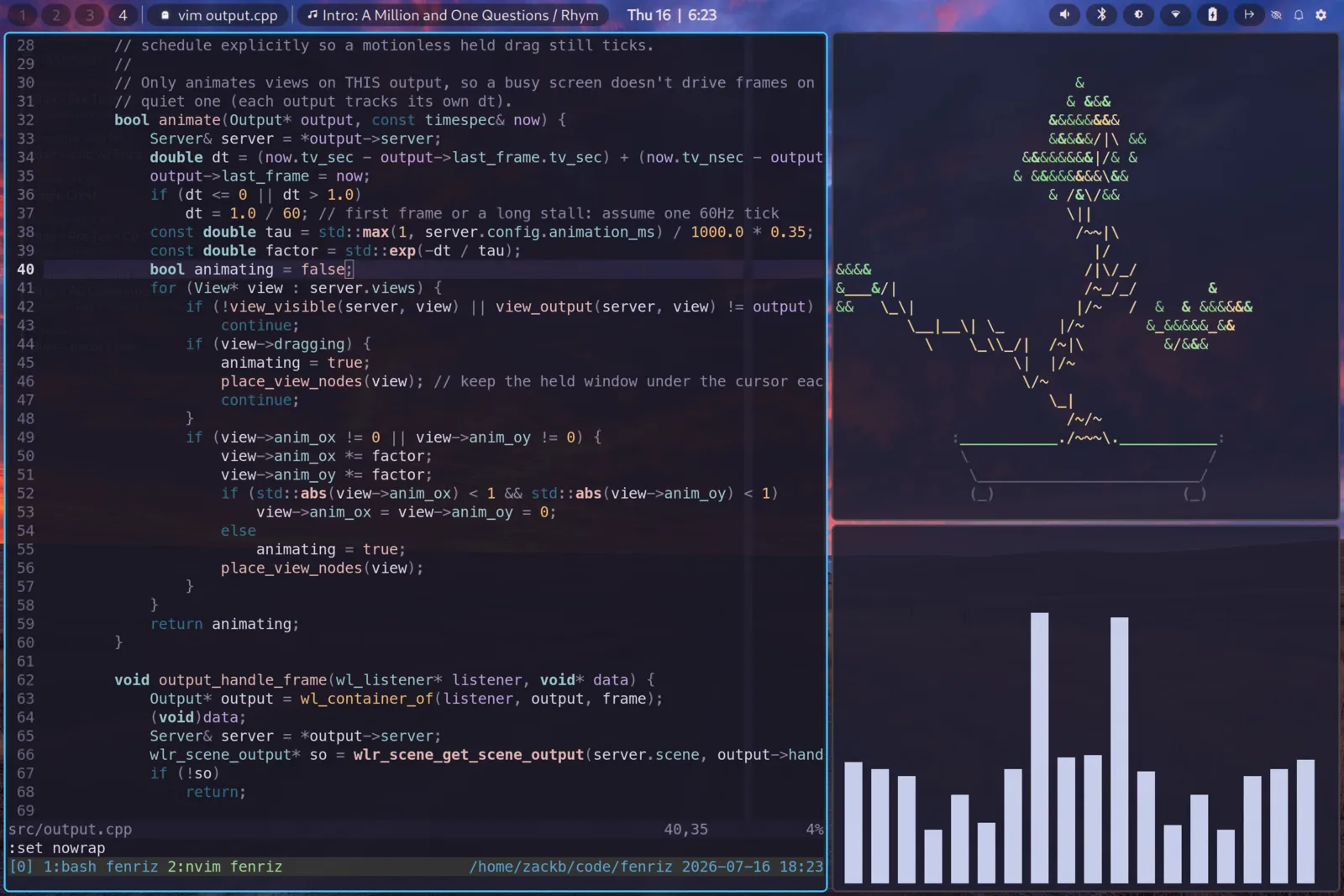
That's it in action, running my Quickshell setup for the bar, with vim open on fenriz's own source. Thin borders, no blur, no bounce. The windows are just there.
And clamshell works. It's not a script and there's nothing to configure. Each workspace lives on an output; when a screen goes away - lid, cable, suspend - its workspaces move to a surviving screen with layout and focus intact, and slide back when it returns. The internal panel turns off when the lid shuts with an external connected, and back on otherwise. Suspend-on-lid is left to logind, which already gets it right. I open and close my laptop lid all day and never think about it, which is exactly how much I want to think about it.
Should you use it?
Probably not, honestly. Use Hyprland. It's more capable than fenriz in every direction that isn't "boot up, tile some windows, close the lid, don't break." It has a real community and it isn't maintained by one d00d.
But in the meantime I have the compositor I always wanted. It does exactly what I want and nothing else, and I have full control. It's my daily driver. It hasn't surprised me yet. My config hasn't broken once :)
I am way open to feedback if anyone is actually interested in using it. It's a small codebase and I can make changes quickly. If you want to try it, here's the repo.